Complete guide
Plug-In Solar Panels UK: Complete Guide
Plug-in solar panels are small solar panel kits designed to feed electricity into your home through a standard mains socket. They are often called balcony solar, plug-in solar or plug-and-play solar.
They are not a replacement for a full rooftop solar system. Instead, they are a smaller, cheaper and more flexible way to reduce the amount of electricity your home imports from the grid during daylight hours.
Compliant plug-in solar kits can now legally be bought and self installed in the UK. This guide explains how they work, the main UK rules, what they cost, how much they could save, where the panels can be installed and what to check before buying.
In this guide
Quick summary
- Plug-in solar panels are small solar kits that connect to your home through a standard plug socket and help power appliances during the day.
- They are designed to reduce your grid electricity use, not replace it. A typical kit can help cover background daytime usage and contribute to appliances that are running, but it will not power a whole home.
- UK plug-in solar kits can use up to four panels, with up to 2,000W of total panel capacity and a maximum microinverter output of 800VA.
- Typical savings can be modest but useful. Our modelling suggests many well-positioned 800W setups could save around £95–£155 a year, depending on location, panel position and household electricity use.
- Plug-in solar can suit homeowners, renters and flat residents, particularly where full rooftop solar is too expensive, not practical or not possible.
- The panels need a bright, secure and permitted outdoor position, with minimal shading, a suitable mounting method, a safe cable route and access to an appropriate socket.
- Compliant plug-in solar is now legal in Great Britain. Kits must meet the UK requirements, be supplied as a complete manufacturer-specified system, and only one plug-in solar device can be connected per household.
- You do not normally need an electrician to install a compliant kit where the existing electrical installation and socket are suitable, but the system must be installed exactly as the manufacturer specifies and registered through ENA's myplugin.solar portal no later than 28 days after installation.
- Make sure the kit is compliant for UK plug-in use before buying. It should be supplied as a complete kit and marked compliant on the official ENA Type Test Register.
What are plug-in solar panels?
Plug-in solar panels are small solar panel systems designed to generate electricity for immediate use in your home. Unlike conventional rooftop solar, compliant kits are designed so they can be installed by ordinary householders without needing a solar installer, provided the home has a suitable existing electrical installation and socket.
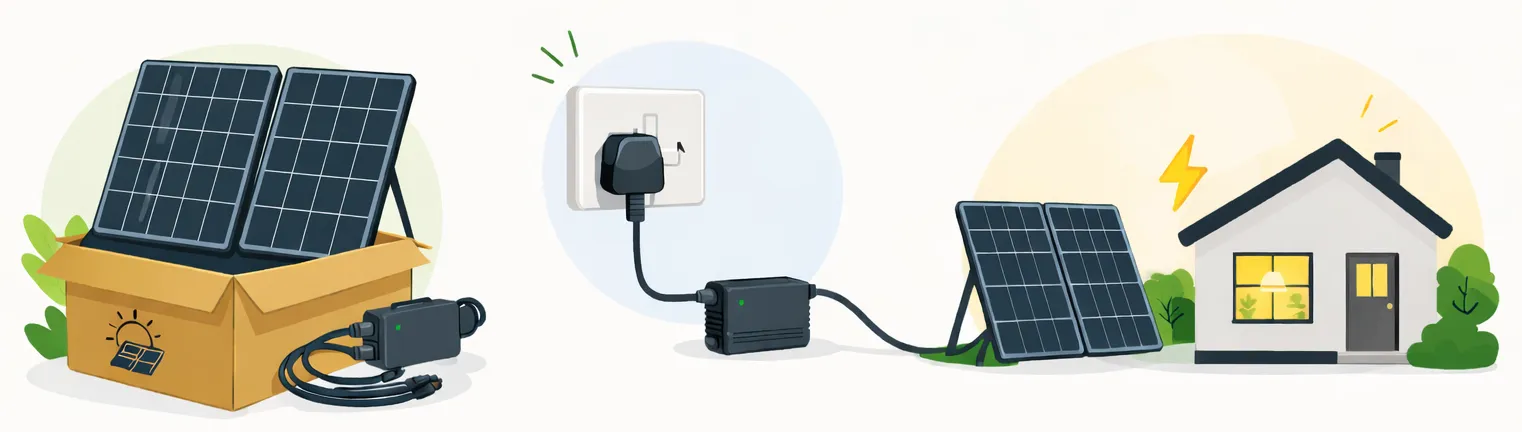
A compliant plug-in solar kit is supplied as a complete system and can include between one and four solar panels, a microinverter, cables, a manufacturer-fitted UK plug, mounting equipment, instructions and safety labels. Once installed, the system feeds the electricity it generates into your home through a standard UK plug socket. You can see each component in more detail in our guide to what is included in a compliant plug-in solar kit.
During daylight hours, that solar electricity can be used by appliances around your home. Your fridge, router, laptop, washing machine, television and other devices may therefore be partly powered by your own solar generation instead of electricity bought from the grid.
The important thing to understand is that plug-in solar is small-scale solar. It is designed to reduce your electricity use from the grid, not to make your home energy independent.
How do plug-in solar panels work?
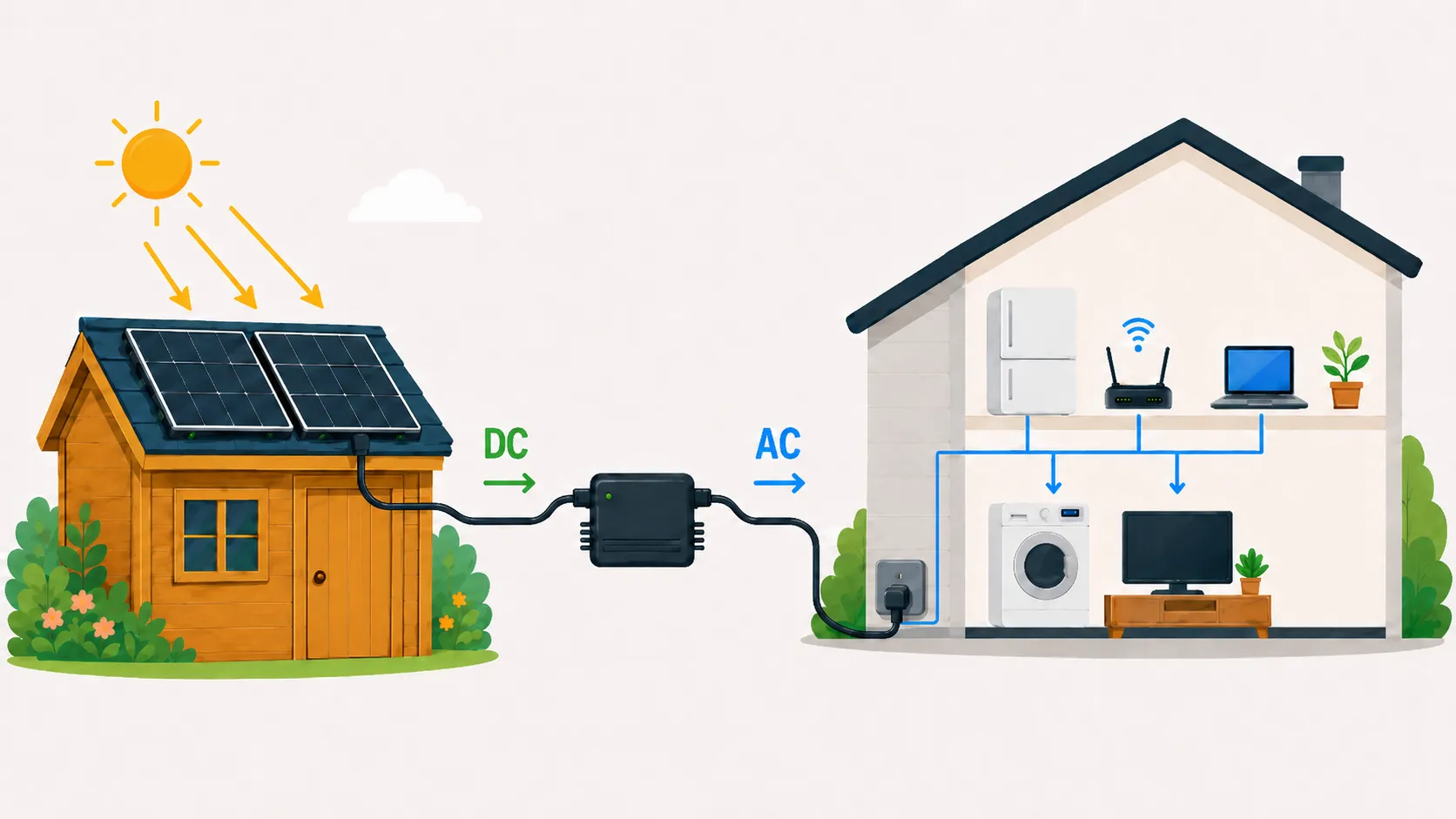
Plug-in solar panels produce DC electricity when exposed to daylight. A small device called a microinverter converts this into AC electricity, which is the type used by normal household appliances.
The converted electricity enters your home's electrical circuit through a suitable plug socket. Appliances that are running at the time can then use that solar-generated electricity before drawing electricity from the grid.
For example, during the day your panels might first help cover always-on electricity use from things such as your fridge-freezer, broadband router and standby devices. If the panels are generating more than that background use, the remaining solar electricity can contribute to appliances such as a laptop, television or washing machine.
If your home needs more electricity than the panels are producing at that moment, the rest comes from the grid as normal. You do not need to manually switch between solar and grid electricity.
If your home is generating more solar electricity than it is using, the excess flows back out to the electricity grid.
Will plug-in solar power my whole house?
No. Plug-in solar is not designed to power a whole home.
It can help cover your home's background electricity use and contribute to other appliances while they are running, but larger loads such as electric showers, ovens, tumble dryers, electric heating or EV chargers will still need additional electricity from the grid.
Your home stays connected to the grid throughout. Think of plug-in solar as a way to trim your electricity use, not replace your electricity supply.
Is plug-in solar legal in the UK?
Yes. Compliant plug-in solar kits can now legally be bought and used in the UK. The new legal route came into force on 27 August 2026.
To qualify, the system must be supplied as a complete compliant kit and installed and used according to the manufacturer’s instructions. Not every plug-in solar product sold online will meet the UK requirements.
Northern Ireland has separate network arrangements, so the rules and registration process are not identical.
What are the main UK plug-in solar rules?
The UK plug-in solar route has clear limits on the size of the system, what can be included and how it connects to your home.
- Maximum output: the microinverter is limited to 800VA, with a maximum operating current of 3.5A.
- Panel capacity: a kit can include up to four solar panels, with no more than 2,000W of total panel capacity.
- One system per household: only one plug-in solar device can be connected at a home. It is not one system per socket or ring circuit.
- Complete kits only: the panels, microinverter, cables, plug and mounting system must be supplied as part of the manufacturer-specified compliant kit.
- No batteries: battery storage is not included in the current plug-in solar route.
- UK plug: the kit must use a manufacturer-fitted, non-rewireable BS 1363 plug, with a fuse rated at no more than 5A.
- Direct socket connection: the supplied plug must connect directly to a suitable socket. Extension leads, multi-way adaptors, plug converters and plug-in RCD adaptors must not be used.
- DIY installation: compliant kits are designed to be self-installed where the existing electrical installation, socket and mounting location are suitable.
- DNO registration: compliant plug-in solar devices must be registered with the electricity network. In Great Britain, registration can be completed through ENA's myplugin.solar portal.
A kit can have more than 800W of solar panel capacity even though the microinverter is limited to 800VA output. For example, two 600W panels give a total panel capacity of 1,200W, but the microinverter still limits the maximum output into the home to 800VA. The benefit is that the extra panel capacity can help the system reach that 800VA limit more often in weaker light, such as on cloudy days or during winter.
All compliant plug-in solar kits sold for UK use must be listed on the Energy Networks Association (ENA) Type Test Register. The register lets buyers check that the complete manufacturer-specified kit has been marked compliant for plug-in solar. You can see the compliant kits listed on our products page. Buying compliant-looking components separately and combining them yourself does not create a compliant plug-in solar kit.
For more detail on compliant kits, system limits, installation, DNO notification and planning, read our complete guide to the UK plug-in solar rules.
How much does plug-in solar cost, generate and save?
How much do plug-in solar kits cost?
Compliant plug-in solar kits are now on sale in the UK, with prices starting at around £350 for smaller single-panel plug-in solar kits. Some two-panel plug-in solar kits are currently available from around £450, although many are priced higher depending on the panels, inverter, mounting system and supplier.
Prices vary considerably between products and suppliers, but competition is increasing as more compliant kits enter the UK market. You can keep track of the latest compliant kit releases, prices, specifications and availability on our plug-in solar products page.
How much electricity does an 800W plug-in solar kit generate?
Across the 124 UK postcode areas in our calculator, an 800W south-facing plug-in solar setup angled at 35 degrees generates around 794 kWh of electricity a year at the median. To put that in perspective, according to Ofgem, the average UK home uses around 2,500 kWh of electricity a year, so an 800W plug-in solar setup in this example could generate electricity equal to almost a third of that annual usage. However, that does not mean it will reduce your electricity bill by a third. Your actual savings depend on how much of that solar electricity your home can use at the time it is being generated.
Actual generation also varies depending on where you live, the direction and angle of the panels, and how much shading they receive. Upright, east or west-facing panels will usually generate less than a well-positioned south-facing system. See our plug-in solar generation guide for detailed UK comparisons.
How much can plug-in solar save and how long does it take to pay back?
Our calculator modelling suggests that many suitable, well-positioned 800W systems could save around £95–£155 per year on electricity bills. How much you actually save depends mainly on:
- how much electricity the panels generate;
- direction, angle and shading;
- the home's always-on baseload;
- how much electricity is used during daylight hours; and
- the electricity unit price.
Households that are at home more during daylight hours will generally save more, because they can use more of the solar electricity as it is generated. But even if nobody is home during the day, plug-in solar can still produce meaningful savings by helping power always-on devices such as fridges, freezers, broadband routers and standby equipment.
For many households, a sensibly priced and well-positioned plug-in solar kit should pay for itself within 3–5 years. The actual payback will depend on the price you pay, how well the system performs, how much of the solar electricity you use yourself and future electricity prices. See our plug-in solar savings guide for a fuller breakdown of expected savings.
Estimate your own savings
Every home is different. Use our plug-in solar calculator to estimate likely generation and savings based on your postcode, panel direction, panel angle, kit size and daytime electricity use.
Calculate my savingsWhere can you install plug-in solar panels?
Plug-in solar panels can be installed in several different ways depending on the space available around your home. The main options are ground-mounted, roof-mounted, wall-mounted and balcony installations. The best location is one that gets good sunlight, can support the panels safely and meets any relevant planning or property rules.
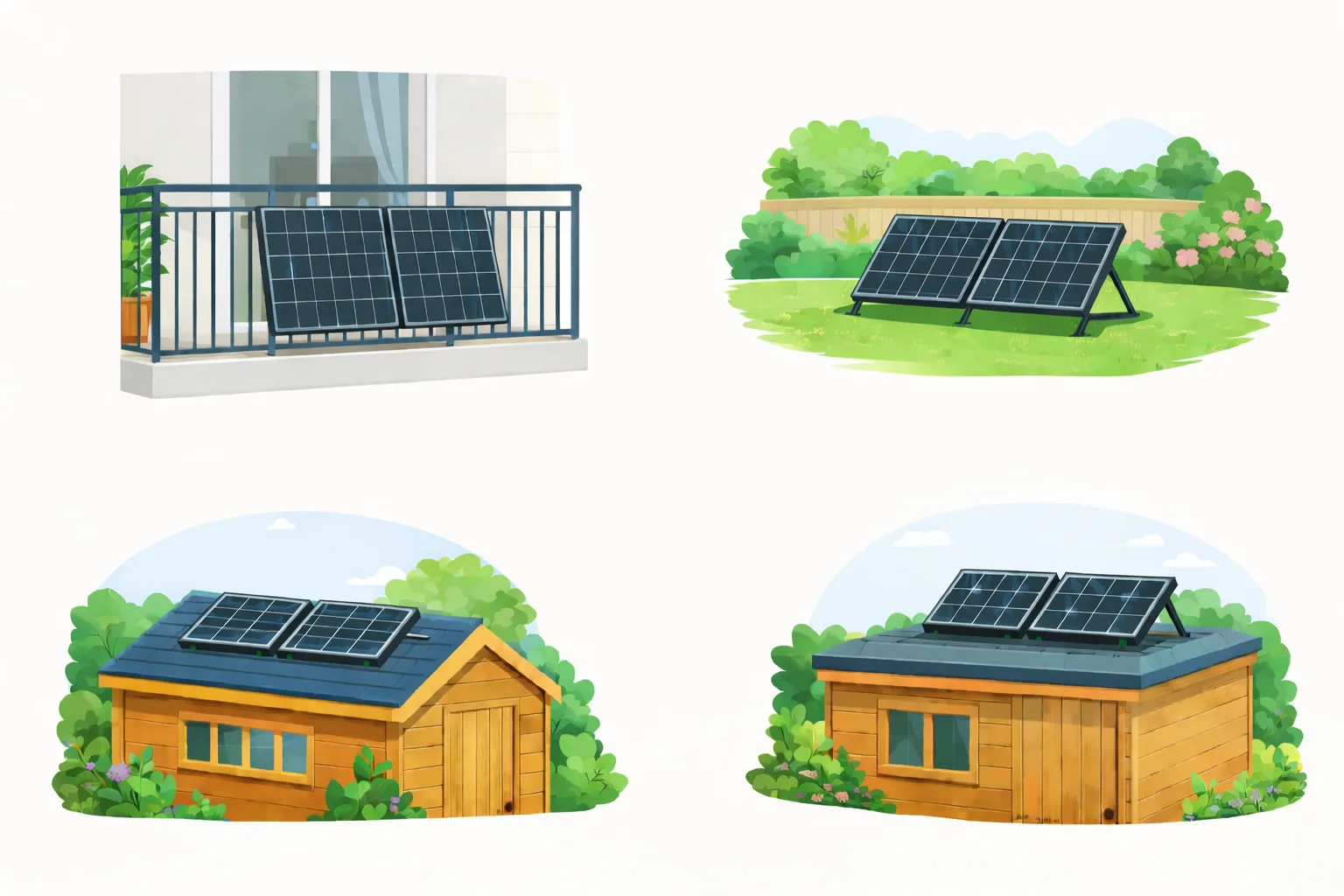
- Ground-mounted freestanding plug-in solar: A good option if you have a garden, patio or other suitable outdoor space. The panels sit on their own frame rather than being attached to a building, which can make them easier to position or move. Check for shading, secure mounting or ballast, cable routing, trip hazards and theft risk.
- Roof-mounted plug-in solar: Panels can be installed on suitable house roofs as well as garages, sheds and other outbuildings. Roof mounting keeps the panels out of the way and can provide a good angle for generation, but you need to consider roof strength and condition, waterproofing, safe fixing and the cable route back to the socket.
- Wall-mounted plug-in solar: Panels can be fixed vertically to an external wall or mounted at an angle where the supplied system allows it. This can work well where garden or roof space is limited. Orientation, suitable fixings, projection limits and any planning or tenancy restrictions all need to be considered.
- Balcony solar: Balcony-mounted panels are particularly useful for flats, apartments and homes without suitable garden or roof space. They are normally attached to a balcony railing or enclosure. Check that the mounting system suits the balcony, and consider wind exposure, secure fixing and whether permission is needed from a landlord, freeholder or managing agent.
South-facing panels normally generate the most electricity over the year, but south-east, south-west, east and west-facing locations can also work well. Upright wall or balcony panels will usually generate less than well-tilted panels, while shading from trees, buildings or railings can reduce output significantly. North-facing panels are generally not recommended for plug-in solar because annual generation is usually much lower. See our plug-in solar generation by location, direction and angle guide for more detailed comparisons.
Panels also need to be mounted securely using the system supplied or specified by the manufacturer, with a safe cable route to the socket. Planning rules and property permissions may also apply: for example, plug-in solar cannot be mounted on timber balconies or timber cladding, and renters or leaseholders may need permission before installing. See our UK plug-in solar rules guide for product and installation requirements, and our guide to where you can install plug-in solar panels in England for detailed planning and location rules.
Who is plug-in solar suitable for?
Plug-in solar is a good fit for people who want a simpler, lower-cost and lower-commitment way to generate some of their own electricity.
It can suit homeowners, renters and flat residents, especially where conventional rooftop solar is too expensive, impractical or simply not possible. It also has the benefit of being portable, so you can take the kit with you if you move home.
The best results usually come from having a bright, secure and permitted place for the panels, with minimal shading and some electricity use during daylight hours. But you do not need to be at home all day to benefit, because always-on devices such as fridges, freezers and broadband routers can still use solar electricity as it is generated.
Plug-in solar may be less suitable if your available space is heavily shaded, you have nowhere safe or permitted to mount the panels, or you are expecting a small plug-in system to power your whole home.
Is plug-in solar safe?
Yes. Compliant plug-in solar is designed to be safe for normal household use, provided the home's existing electrical installation and socket are suitable and the kit is installed exactly as the manufacturer specifies. Electrical Safety First recommends that circuits used for plug-in solar are protected by at least a Type A bidirectional RCD, and says homes with Type AC RCDs should not use plug-in solar without first upgrading the protection on those circuits. Any necessary upgrade should be carried out by a competent electrician.
Compliant kits include specific electrical safety protections, are limited to 800VA output and must connect directly to a suitable socket without extension leads or multi-way adaptors. For high-power plug-in solar kits with more than 960W of total panel capacity, the UK product specification also recommends considering a professional assessment of the existing electrical installation.
Can you install plug-in solar yourself?
One of the main benefits of plug-in solar is that compliant kits are designed for DIY installation at home. You do not normally need a solar installer or electrician: the panels are mounted as instructed and the supplied plug connects directly to a suitable existing socket.
You should still get professional advice if you are unsure about the condition of your wiring or socket, if any fixed electrical work is required, or if the manufacturer’s instructions recommend it. For kits with more than 960W of solar panel capacity, manufacturers must also advise you to consider having your existing electrical installation professionally assessed.
If you rent your home, you should get written permission from your landlord before installing a kit. Flat owners and leaseholders may also need permission from a freeholder or managing agent, particularly where panels are being attached to a balcony, wall or other shared part of the building. See our plug-in solar for renters guide for more detailed advice on permissions.
What happens to unused solar electricity?
If your panels generate more electricity than your home is using, the excess automatically flows back into the electricity grid. You will not automatically be paid for that exported electricity.
Plug-in solar does not currently qualify for the normal Smart Export Guarantee route. However, Octopus Energy now offers its Outgoing Prime export tariff to eligible plug-in solar customers, while other suppliers including British Gas and Fuse Energy are still developing their own export options.
Unless your supplier has confirmed that your plug-in solar setup is eligible for an export tariff, it is safest to assume that any excess electricity will be exported without payment. Our calculator therefore currently excludes export income from its savings estimates.
Export payments are likely to be a relatively small extra for most households. Our modelling suggests around £4–£8 a year for 400W systems, £18–£29 for 800W systems and £34–£52 for systems with 1,200W of panel capacity. See our plug-in solar export payments guide for supplier eligibility, likely requirements and the full modelling.
Plug-in solar vs rooftop solar
Plug-in solar and conventional rooftop solar serve different needs. Plug-in solar is smaller, cheaper and more flexible, while rooftop solar costs considerably more but can generate much more electricity. Neither is necessarily better — it depends on your home, budget and what you want from solar.
| Feature | Plug-in solar | Rooftop solar |
|---|---|---|
| Typical upfront cost | Typical kit prices range from £350 to £650 | Usually several thousand pounds |
| Installation | Designed for DIY installation using a suitable existing socket | Professional installation required |
| Best for | People wanting a smaller, lower-cost and more flexible solar setup | Homeowners with a suitable roof and larger budget |
| Energy generation | Lower — maximum 800VA output | Much higher — multi-kilowatt systems are common |
| Typical savings | Around £95–£155 a year for many suitable 800W setups | Typically much higher, depending on system size and household use |
| Portability | Portable — you can take the kit with you if you move | Fixed to the property |
| Export payments | Not automatic; export tariffs are available to some eligible customers | Export tariffs are commonly available where eligible |
| Commitment | Low | Higher |
| Visual impact | Smaller installation, but panels are often at ground, wall or balcony level | Larger array, usually installed on the roof |
Where can you buy plug-in solar panels in the UK?
Compliant plug-in solar kits are now available from a growing range of UK retailers, manufacturers and specialist suppliers. Current sellers include major retailers such as Argos, Amazon, City Plumbing and Screwfix, alongside brands and suppliers selling directly to customers.
Before buying, check that the exact complete kit is marked compliant in the Plug-in Solar category of the ENA Type Test Register. You can keep track of the latest compliant kit releases, prices and availability on our plug-in solar products page.
What should you check before buying a plug-in solar kit?
Before buying, make sure the kit is compliant, suitable for where you want to install it and likely to work well for your home. A few checks beforehand can help avoid buying a system that cannot be installed as intended.
- Check that the complete kit is compliant. Only buy a complete manufacturer-specified kit that is marked compliant in the Plug-in Solar category of the ENA Type Test Register. A compliant microinverter or UK plug on its own is not enough. Our plug-in solar products page lists compliant kits for the UK market.
- Make sure it will work well where you want to install it. Think about direction, shading and how the panels will be mounted. South-facing is normally best, while east and west can also work well. North-facing panels are generally not recommended. Check that the mounting system supplied with the kit is suitable for your intended balcony, garden, wall or roof location.
- Check the cable can safely reach a suitable socket. The supplied plug must connect directly to a suitable socket. Extension leads, multi-way adaptors and plug converters cannot be used.
- Check whether you need permission. Renters should get permission from their landlord, while leaseholders and flat owners may need approval from a freeholder or managing agent. Planning and installation restrictions can also affect some locations. See our UK plug-in solar rules guide for the detailed requirements.
- Make sure your electrical setup is suitable. A compliant kit is designed to plug into a suitable existing socket. If your wiring or socket is old, damaged or you are unsure about its condition, it is sensible to have it checked first. For kits with more than 960W of panel capacity, manufacturers must also advise you to consider a professional assessment of the existing electrical installation.
- Check that the price and kit size make sense for your home. A larger or more expensive kit will not automatically give you better value. Generation depends on where the panels are installed, while savings depend on how much of that electricity your home can use. Use our plug-in solar calculator to compare likely generation, savings and payback for different kit sizes.
Frequently asked questions
Are plug-in solar panels legal in the UK?
Yes. From 27 August 2026, compliant plug-in solar kits can legally be bought and used in Great Britain. Northern Ireland has separate network arrangements.
How much do plug-in solar panels cost?
Compliant plug-in solar kits currently start at around £350 for smaller single-panel systems. Some two-panel kits are available from around £450, although many cost more depending on the panels, inverter, mounting system and supplier.
How much money can plug-in solar save?
Our modelling suggests that many suitable, well-positioned 800W systems could save around £95–£155 a year. Actual savings depend on where the panels are installed, shading, household electricity use and electricity prices.
Are plug-in solar panels worth it?
Yes. Plug-in solar can offer a very good return on investment, particularly because the upfront cost is much lower than a conventional rooftop solar system. For a suitably positioned system bought at a sensible price, our modelling suggests annual savings of around £95–£155 and a potential payback period of roughly 3–5 years.
How do I know if a plug-in solar kit is compliant?
Check that the complete manufacturer-specified kit is marked compliant in the Plug-in Solar category of the ENA Type Test Register. Buying compliant-looking panels, a microinverter and a plug separately does not create a compliant plug-in solar kit.
Do I need an electrician to install plug-in solar?
Not necessarily for installing the kit itself, because compliant systems are designed for DIY installation. However, your existing electrical installation and socket must be suitable. Electrical Safety First recommends having the installation assessed by a competent electrician registered with a competent person scheme before buying or using plug-in solar, particularly in older homes or where the condition of the wiring and protective devices is unknown. It also recommends that circuits used for plug-in solar have at least a Type A bidirectional RCD; circuits protected by Type AC RCDs should be upgraded before use. You should also get professional help if fixed electrical work is required. For kits with more than 960W of panel capacity, manufacturers must advise users to consider a professional assessment of the existing installation.
Can renters and flat residents use plug-in solar?
Potentially. Renters should get permission from their landlord, while leaseholders and flat owners may need approval from a freeholder or managing agent. There may also be restrictions on where and how the panels can be mounted.
Do I need planning permission for plug-in solar panels?
Often not, but it depends on where you live and where the panels are installed. In England, many plug-in solar installations can fall within permitted development rights, but there are specific limits for balconies, walls, roofs and stand-alone panels, as well as extra restrictions for listed buildings and protected areas. Planning rules differ across the UK, so check the rules that apply where you live before installing. See our guide to where you can install plug-in solar panels in England for the detailed planning requirements.
How many plug-in solar kits can I install?
Under the current Great Britain network rules, only one plug-in solar device can be connected per household.
Do I need to register plug-in solar with my DNO?
Yes. Compliant plug-in solar devices in Great Britain can be registered through ENA's myplugin.solar portal. Registration must be completed no later than 28 days after installation, and the portal automatically sends the notification to the DNO responsible for your address.
What happens to solar electricity I don't use?
Any electricity your home cannot use automatically flows back into the grid. You will not automatically be paid for it. Octopus Energy now offers an export tariff to eligible plug-in solar customers, while other suppliers including British Gas and Fuse Energy are still developing their own export options. Our calculator currently excludes export income. See our export payments guide for the latest position.
Does plug-in solar work in winter and cloudy weather?
Yes. Solar panels still generate electricity in cloudy weather and during winter, but output will be lower. Winter generation is usually considerably lower because daylight hours are shorter and the sun is lower in the sky.
Sources
This guide draws on the following official and specialist sources:
- Department for Energy Security and Net Zero: Plug-in solar consultation outcome and government response for the legal framework, policy decisions, safety requirements and implementation plans.
- Department for Energy Security and Net Zero: Plug-in Solar Device Interim Product Specification, Version 2.0 for the product, output, installation, marking, testing and consumer-information requirements.
- UK Parliament: SI 2026/848 details for the statutory instrument and its 27 August 2026 coming-into-force date.
- Ofgem: DCRP/MP/26/02 Distribution Code changes for the approval and implementation of the G98 network changes for plug-in solar.
- GOV.UK: Register energy devices in homes or small businesses for DNO notification and registration guidance.
- UK legislation: SI 2026/896 for the permitted development rules for plug-in solar in England.
- Energy Networks Association: Plug-in Solar Type Test Register for complete kits marked compliant for UK plug-in use.
- Electrical Safety First: Plug-in solar panels for its recommendations on RCD protection and assessment of existing electrical installations.
- European Commission: Photovoltaic Geographical Information System for the solar-generation data used by the calculator.
- Ofgem: Review of typical domestic consumption values for the annual household electricity-use comparison.
Update history
- 18 September 2026: Revised costs and where to buy sections to reflect the latest retailer availability and pricing.
- 17 September 2026: Updated export payment guidance to reflect Octopus Energy's newly published information on plug-in solar export tariff eligibility.
- 9 September 2026: Updated buying guidance to reflect the growing range of compliant kits now available from manufacturers, specialist suppliers and major UK retailers.
- 6 September 2026: Expanded the electrical-safety and electrician guidance to include RCD recommendations, assessment advice for existing installations and the professional-assessment threshold for larger systems.
- 29 August 2026: Updated export-payment guidance and linked to the dedicated supplier, eligibility and export-value guide.
- 28 August 2026: Updated DNO registration guidance for the ENA's myplugin.solar portal and its 28-day registration process.
- 27 August 2026: Major rewrite for the live UK plug-in solar framework, simplifying the guide, removing pre-launch information and updating the rules, buying, installation and product guidance.
- 19 August 2026: Updated export-payment guidance to reflect developing plug-in solar tariff plans.
- 28 July 2026: Added DNO notification guidance and linked to the dedicated DNO registration guide.
- 24 July 2026: Aligned renter, flat and permission guidance with the dedicated renters guide, including clearer written-consent advice.
- 20 July 2026: Updated legal-status, availability and FAQ wording to reflect the statutory instrument start date of 27 August 2026.
- 17 July 2026: Aligned battery, export and product-compliance wording with the published interim specification.
- 16 July 2026: Updated the guide after publication of the government response and Plug-in Solar Device Interim Product Specification Version 2.0.
- 2 July 2026: Refreshed the timeline and availability guidance as the UK plug-in solar route developed.
- 29 June 2026: First published as a plain-English guide to UK plug-in solar panels, costs, savings and rules.